

Listening to backtalk
I have the privilege of meeting superstar scholar Kimberlé Williams Crenshaw and hearing the stories behind her work on intersectionality. I also learn my body is failing fast.

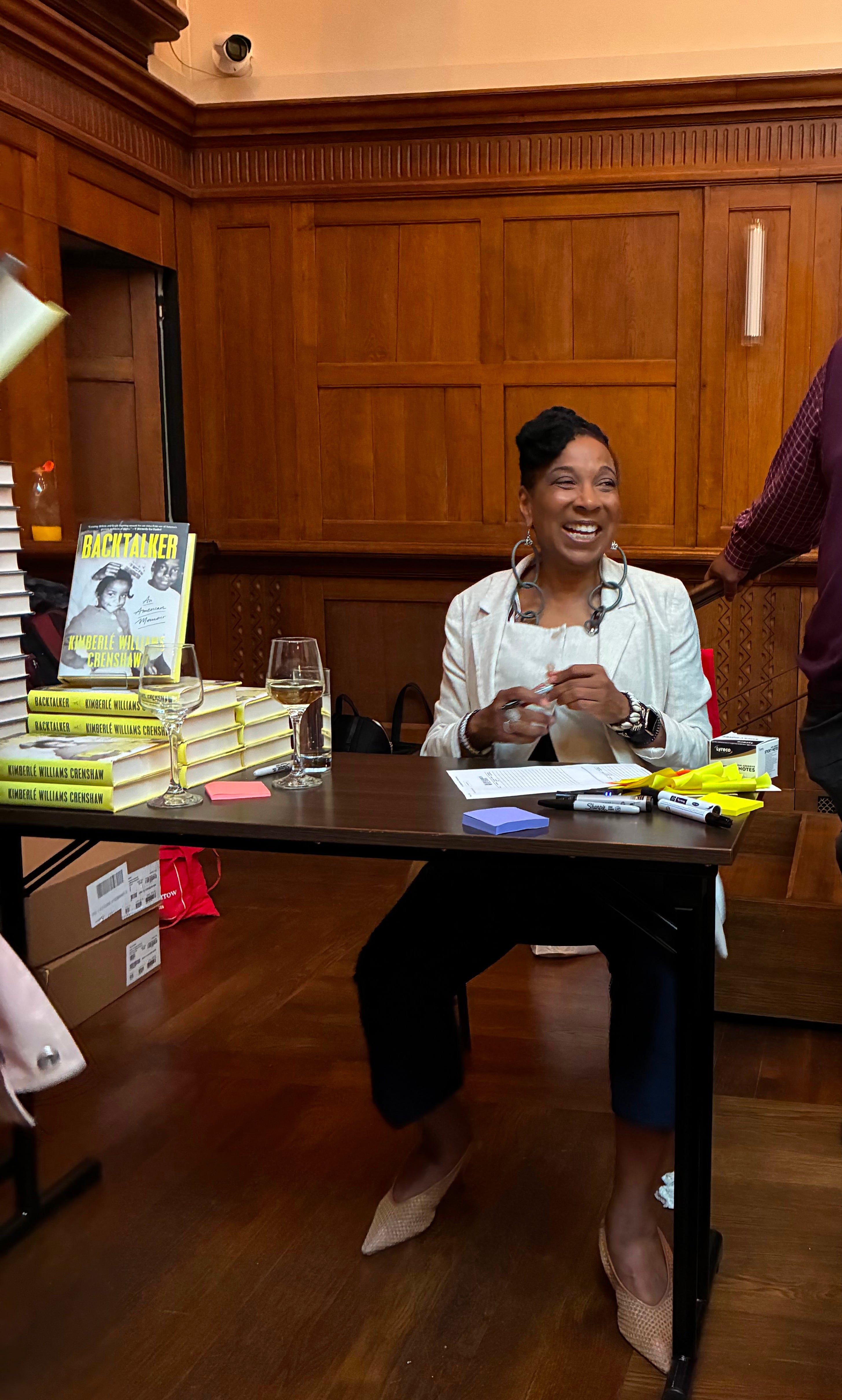
When I heard that Kimberlé Williams Crenshaw would be speaking in Paris this week, I went all fangirl. Kimberlé Williams Crenshaw in real life! I couldn’t believe it. I had to see her.
When I was working on my PhD at the University of Birmingham in England, the first articles my supervisor suggested to me were by Kimberlé Williams Crenshaw. Crenshaw is the luminary who came up with the ideas of intersectionality and critical race theory. Two things that terrify the US president so much he has banned those words from federal websites. States have banned teachers from even discussing the ideas. Yet they are two ideas that make perfect sense to anyone paying attention to history.
Intersectionality, for those unfamiliar with the term, simply recognizes that race, gender, and class overlap to create unique forms of discrimination. If you’re Black, you face racism. If you’re female, you face misogyny. If you’re both, you face a hybrid of the two. If you’re Black, female, and gay, you face a toxic cocktail of three kinds of discrimination.
Critical race theory argues that racism is structural. Which it has been since the birth of the United States. Our systems were set up to advantage white people; there has always been racial bias in our laws and legal institutions.
Crenshaw is a distinguished law professor at the University of California, Los Angeles and at the Columbia Law School. She’s an intellectual rock star, publishing scores of academic and popular articles.
And now she has published a memoir. This memoir, Backtalker, was the occasion for her trip to Paris.
But by the time I tried to register for the event, it was full. Unsurprisingly. The day before, Crenshaw drew a crowd of 900 in Nantes. Desperate, I asked Penelope, owner of the Red Wheelbarrow Bookstore, if she needed help selling books at the event. She did! I was overjoyed.
Reid Hall was overflowing with buzzing fans. In conversation with Keithley Woolward, associate director of the Columbia M.A. in History and Literature, Crenshaw began to speak about the personal experiences that came to shape her work. I took notes as fast as I could, but I couldn’t capture everything. I’ll do my best to share some of her words.
Woolward first asked her why the American edition of her book included the subtitle “An American Memoir,” whereas the British edition simply calls it “A Memoir.”
In the orgy of Americanism we are about to have, she said, I thought it important to make visible parts of the celebration that will be erased. “This is an American story, part of a reflection of who we are. Intersectionality and Critical race theory are deeply American.”
The memoir endeavors to translate personal history into collective history. Her desire to do it was informed by disappointment and shock when her ideas became weaponized by the far right. Any forward momentum creates a backlash, she said. She just hadn’t realized how bad the backlash would be.
In the news, Trump has called on Americans to “lay down their lives to defend the US against critical race theory,” which strikes me as one of the most ridiculous sentences ever uttered.
Crenshaw’s book shows how the stories of her life evolved into her academic ideas. “All of our disciplines are grounded in stories, especially law,” she said. “Law is about who can tell the best story.”
Crenshaw grew up in a musical family. “I exist because of music,” she said. Her parents met in Canton, Ohio, where her father was looking for a pianist to accompany his own music.
“They clearly made magical music together,” said Crenshaw. She was born two years later. She herself was never as musical as the rest of her family. Her mother consoled her, saying “Don’t worry baby, you can’t sing but you can talk.”
We believed we were on an upward trajectory, she said. That belief was deeply embedded in the music they sang, in choirs and at home. (“This Land is Your Land, This Land is My Land,” etc.). Her father sang her songs from South Pacific, “You got to have a dream, If you don’t have a dream, How you gonna have a dream come true?”
Crenshaw talked about incidents of racism that shaped her childhood. One such incident occurred when her music teacher stole her melodica, gave it to her daughter to play, and shoved a nasty one in Crenshaw’s hand. When she told her mother, her mother went out and bought her a two-octave keyboard.
In school, Crenshaw was supposed to play Lorraine Hansberry in her play To Be Young, Gifted, and Black but the school canceled the production, choosing instead to produce the deeply problematic Blackboard Jungle. Later, instead of playing visionary playwright Lorraine Hansberry, Crenshaw ended up playing the maid in My Fair Lady.
“There should have been a feminist critique,” Crenshaw said. “But there wasn’t. A play was not worth fighting about.”
After Crenshaw’s father died young and her brother was killed, the household darkened. In the 1960s, “we were pummeled in the political culture.” A report authored by Asssistant Secretary of Labor Patrick Moynihan suggested that the rise in Black single-mother families was due to immorality in ghetto culture. But in Crenshaw’s family, her mother ended up a single head of household simply because her husband died.
“I started the book with the backstories of the articles I published,” Crenshaw said. Things she couldn’t unspool in academic pieces. “One does not begin legal scholarship with ‘it happened to me.’”
One thing that happened to her was that an ex-boyfriend assaulted and nearly killed her. How her community talked her into dropping charges, saying they would protect her. But that the moment the man was free, he began stalking her again. “I did not get protection.” It was a failure of sisterhood, she said.
In university, she studied both government and Africana studies. Her classes on government were in the center of campus, and her classes on Africana studies were, tellingly, on the margins of campus. So she studied government, then studied “what is being left out of the government project.” Her mind was thus shaped in a dialectical way.
There is a lot I am leaving out here, her stories about imposter syndrome and bonding with Toni Morrison and Angela Davis. Her stories about being in the room with Anita Hill. I can’t include everything. You have to read the book.
So the title. In the African American cultural tradition to be a backtalker is to be in defiance of the expectation that you maintain silence in the face of brutal authoritarian figures, discrimination, inequality, etc, she said.
Backtalk as a verb is the act of turning a critical eye to things we are told are unfixable or “just the way things are.”
Knowledge production is grounded in dissent, she said. “I want backtalk to encompass frank talk that allows us to imagine a different reality.” Sometimes that means creating a language.
Crenshaw ended her talk by reading part of her book’s epilogue. On March 7, 1965, in Selma, Alabama, a day to become known as Bloody Sunday, state troopers violently attacked some 600 civil rights protestors. The words to tell this story are being erased by the current administration and the anti-woke. Trump wants to limit words, to use suppression, force, and power to erase the past.
“We are a target of censorship,” she says. “This is a war that produces human casualties.”
Legal education must give us the tools to move away from our past.
In response to an audience question about the effects of misogynoir, the syngergistic force of anti-Black racist misogyny that Black women experience, particularly in US visual and digital culture, Crenshaw said, “The costs of misogynoir extend to the entire nation. Perhaps the costs are global.”
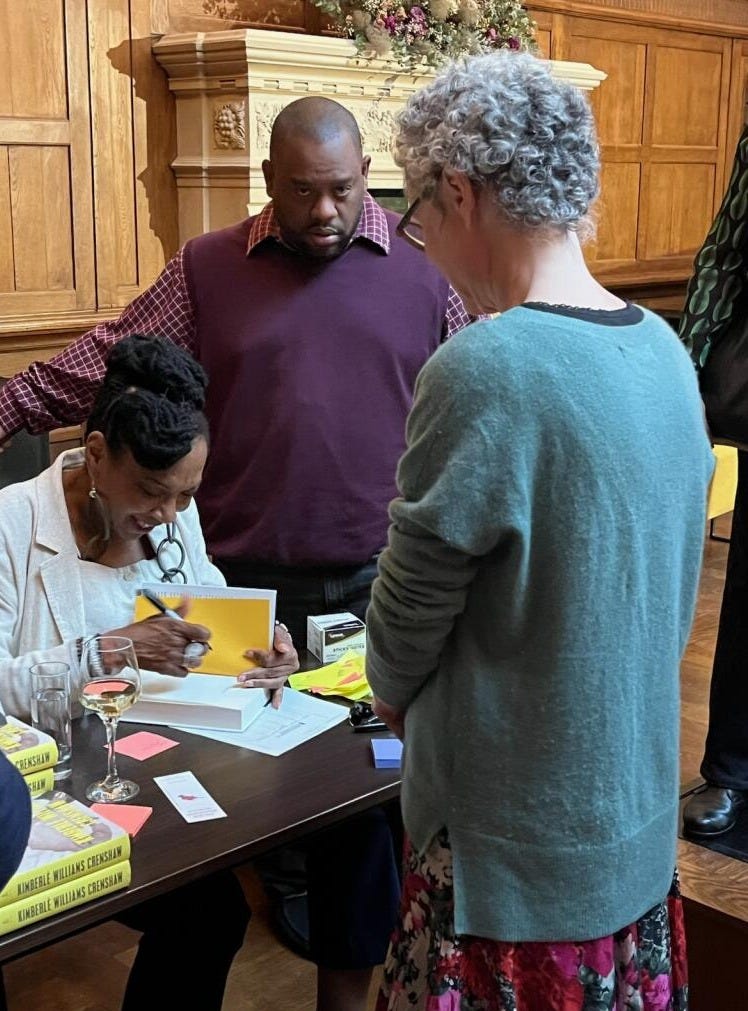
Yes, I got a signed copy of her book. Which you can still buy at The Red Wheelbarrow Bookstore. I told her I discovered her work while working on my PhD and she asked what my degree was in. “Creative writing,” I said. “I’m a novelist.”
“Wow!” she said. As if she were actually impressed. It could be she is just very nice.
On a personal level, a lot happened this week. I learned that my kidney failure is worsening, my red blood cells continue to decline, and my tumor markers are rising fast. I cannot receive any treatment while in renal failure and my doctor does not know what is causing the failure. I am in a panic about this, falling down a dark hole. I struggle to find anything to hold on to to keep my mind aboveground. I have been keeping myself relentlessly busy so I don’t dwell. I’ve been to two playreading groups and one poetry group this week.
I’ve also gotten to spend an entire day with one of my favorite humans in the entire world, Helen Walne, who lives in Capetown and is a brilliant writer and underwater photographer. She took the stunning photo for the cover of Time magazine this month. Her visit was so brief it feels like a dream, but it was such a happy dream.
My daughter also had a busy week, as she had both her French and her Math baccalaureate exams. She studied like demon, so I hope she did well. I’ve never seen anyone so disciplined. When she came home from that last written exam, I asked her what she wanted to do with the rest of the day. “I assume you’re not studying,” I said. “So what do you want to do? Go to an amusement park?” I said it without thinking, but she was immediately enthusiastic.
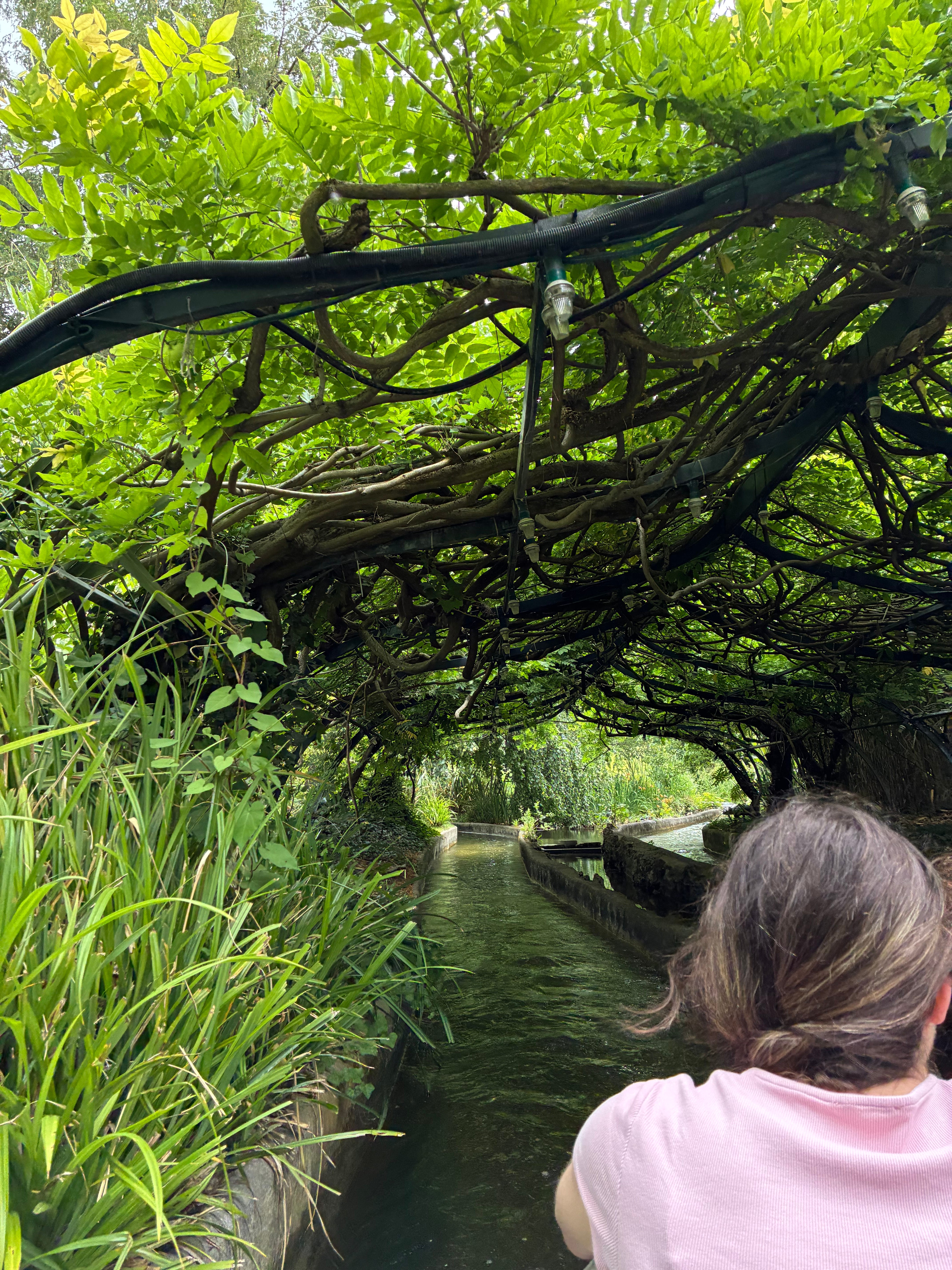
So as a special treat we went to the Jardin d’Acclimatation, an amusement park in the Bois de Bologne. It was a coolish afternoon, and there were no lines anywhere. No lines to get in, no lines for rides, no lines at the restaurants. You could just walk right up. I’ve never been to a less populated amusement park; it was bliss. I have sworn off roller coasters and anything that spins me in a circle, but Theo talked me into going on not one but two roller coasters with her. And I survived. While we had fun wandering the beautiful park and hopping on the rides, we were both so exhausted by the end of the afternoon we could barely drag ourselves to the metro.
Everything is suddenly more precious than ever before. Putting away my socks. Showering. Eating cherries. These quotidien activities. I want to listen to Olivia Rodriguez’s new album so I know what my daughter’s so excited about. I want to cut up a pineapple. I want to make dinner. So I do these things (okay so Tim ended up cutting up the pineapple). And I wait.
And we wait with you - meanwhile celebrating the fact that you make things happen!
It is an enormous act of generosity to share with us your experiences, good and bad. I suspect your complicated circumstances forge an intensity that demands an audience, and for that (and other things) I am extremely grateful. We're all rooting for you, of course. There's something truly magical about having an amusement park "to yourself." So pleased we got to hear about it.