

Looking back in anger
The blood test every woman should demand, a new podcast interview, and a few thoughts on my recent reading.

I’ve spent much of the past couple of weeks going through all of my journals since Theo was born and copying my observations into documents for her. A side effect of this process is that I am reminded that I was having absolute textbook symptoms of ovarian cancer for years before I was diagnosed. The oncologist who diagnosed me in 2022 said I’d probably had the cancer for around four years.
In 2018, nearly every one of my journal entries describes excruciating abdominal pain. Nearly every single one. I was in so much pain I cut out coffee, tomatoes, oranges, chocolate, and alcohol, eating mostly porridge and bananas. Yet while I regularly went to our local doctor in London, he never ordered the simple blood test that could have saved my life. An endoscopy showed no sign of gastritis, so he blamed my abdominal issues on menopause and stress. Had I been diagnosed at stage one, I could have lived to see my daughter grow up. The helpless rage and grief I feel about this is infinite, even while I acknowledge it is not useful to want to change the past.
Almost all women with ovarian cancer are diagnosed too late for their lives to be saved, because doctors refuse to do any screening for it. They don’t want to order the CA125 blood test, because if it shows elevated tumor markers, they then need to order expensive scans to confirm cancer. Other inflammatory conditions could cause elevated CA125 markers, but I would think that these would also be useful for a patient to know . I wrote about this in an essay I wrote for the Kenyon Review a few years ago.
https://kenyonreview.org/piece/eviscerations/
I wish that ovarian cancer screening were as regular as breast cancer screening. I wish that we didn’t all die because this is not the case. If you are female and older than 50, ask your doctor for the blood tests. Demand it.
This was not what I sat down to write, but this is what bubbled up. What is always lurking.
This has been a quiet week. The visiting nurses have started coming three times a week to drain my abdomen and change my bandages. So our tiny flat is now filled with large cartons of medical supplies. My blood pressure is unusually very high, which one nurse said is a result of the Avastin I just started receiving to help with the ascites.
Because I need to leave the flat at least once a day to stay sane, I have met with several friends. A palliative care doctor gave me auricular therapy, which is a kind of ear acupuncture that involves freezing various points on the ear that allegedly correspond to other parts of the body and mind. He poked points in my ear, asking if they hurt. He then applied an icy needle to the sensitive parts. He spent a long time staring at my ears. “You have an emotional blockage,” he said.
I wondered how this was possible, when I am so emotional all the time. I am feeling my feelings. Are there still more emotions somewhere that are stuck? What are they about? He didn’t offer further information. I’m not at all sure I want these emotions unstuck, as I have a tough time managing the emotions I already have. But maybe the stuck emotions are joy and Zenlike calm! In which case, I want them.
Theo has been ringing us from her tour of American universities, and it’s been exciting to hear all about them. Our friend Jill organized a truly impressive itinerary that included colleges in Chicago, Ohio, Minnesota, Vermont, New York, and Connecticut.
Theo asks how I am and I tell her. She asks how much time I have left and I don’t know what to tell her.
“I’m sorry I’m not there,” she says.
“Sweetheart, you’d be miserable here.”
“Yes. But I am sorry for you that I am not there.”
And I say, “I would rather you be happy and there than sad and here.”
Which is true.
Theo also rang us with some happy news. A play she wrote is going to be produced at her summer camp, and she will get to direct it. She is absolutely thrilled. As are we!
Outing of the week
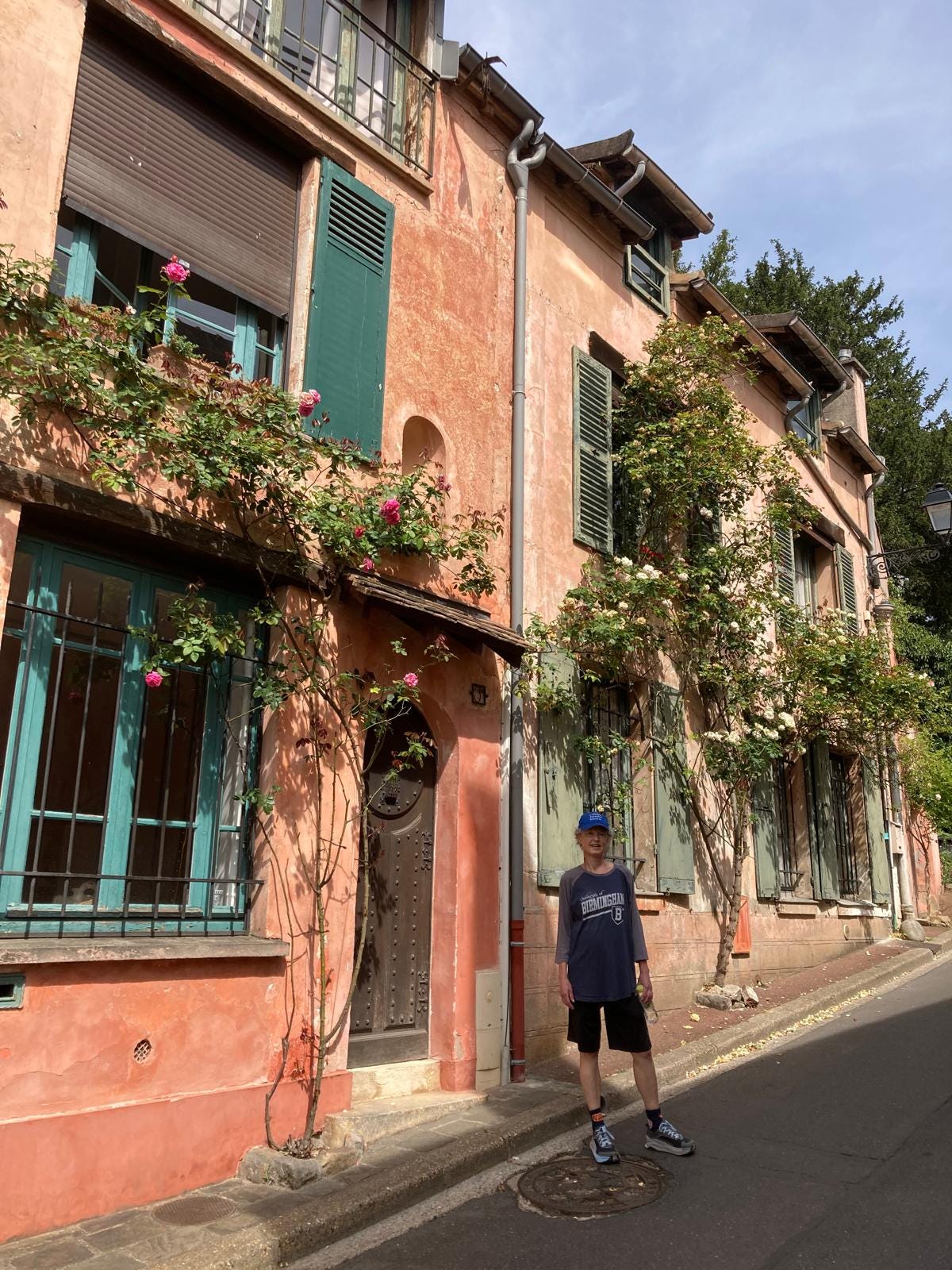
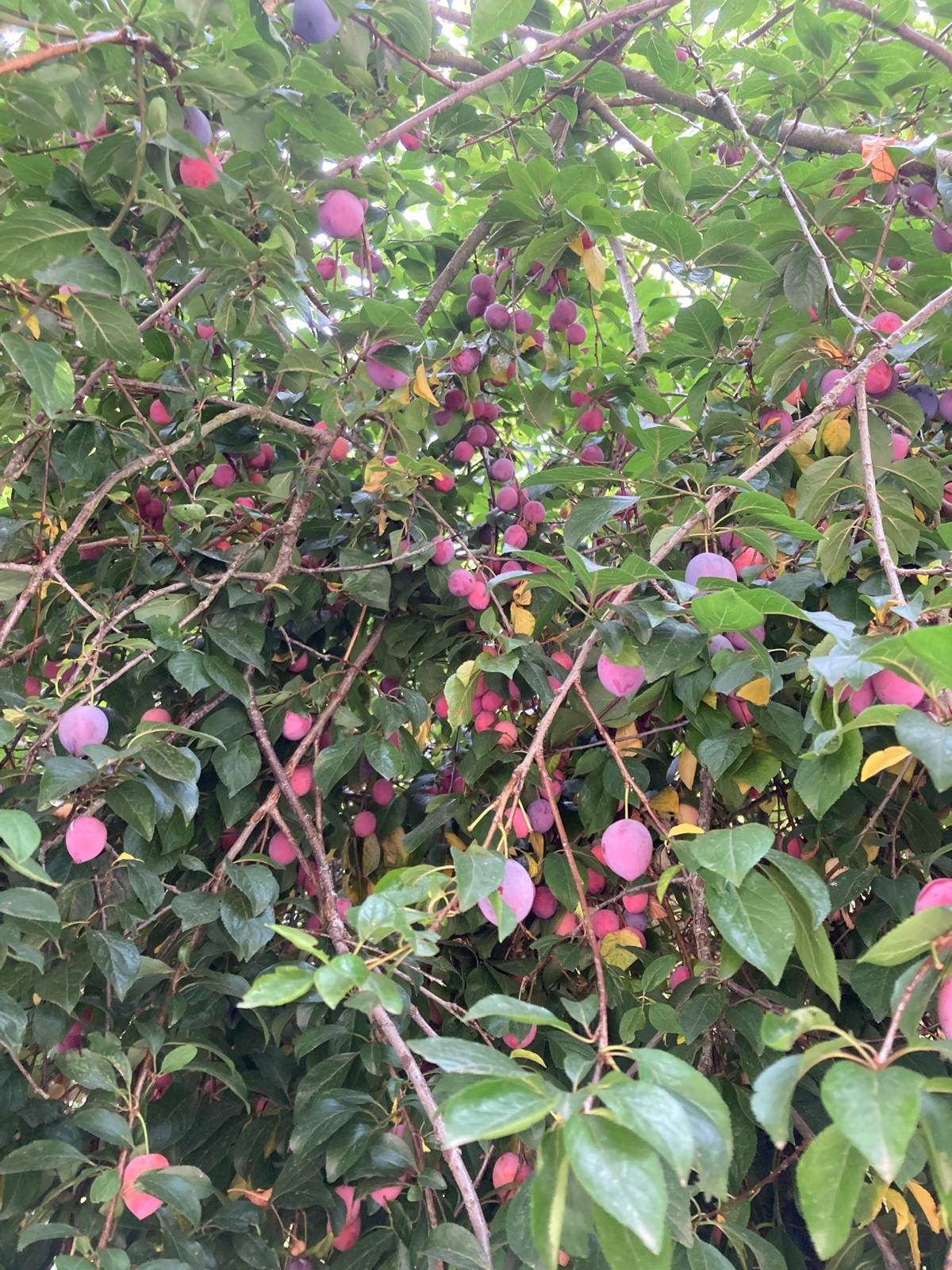
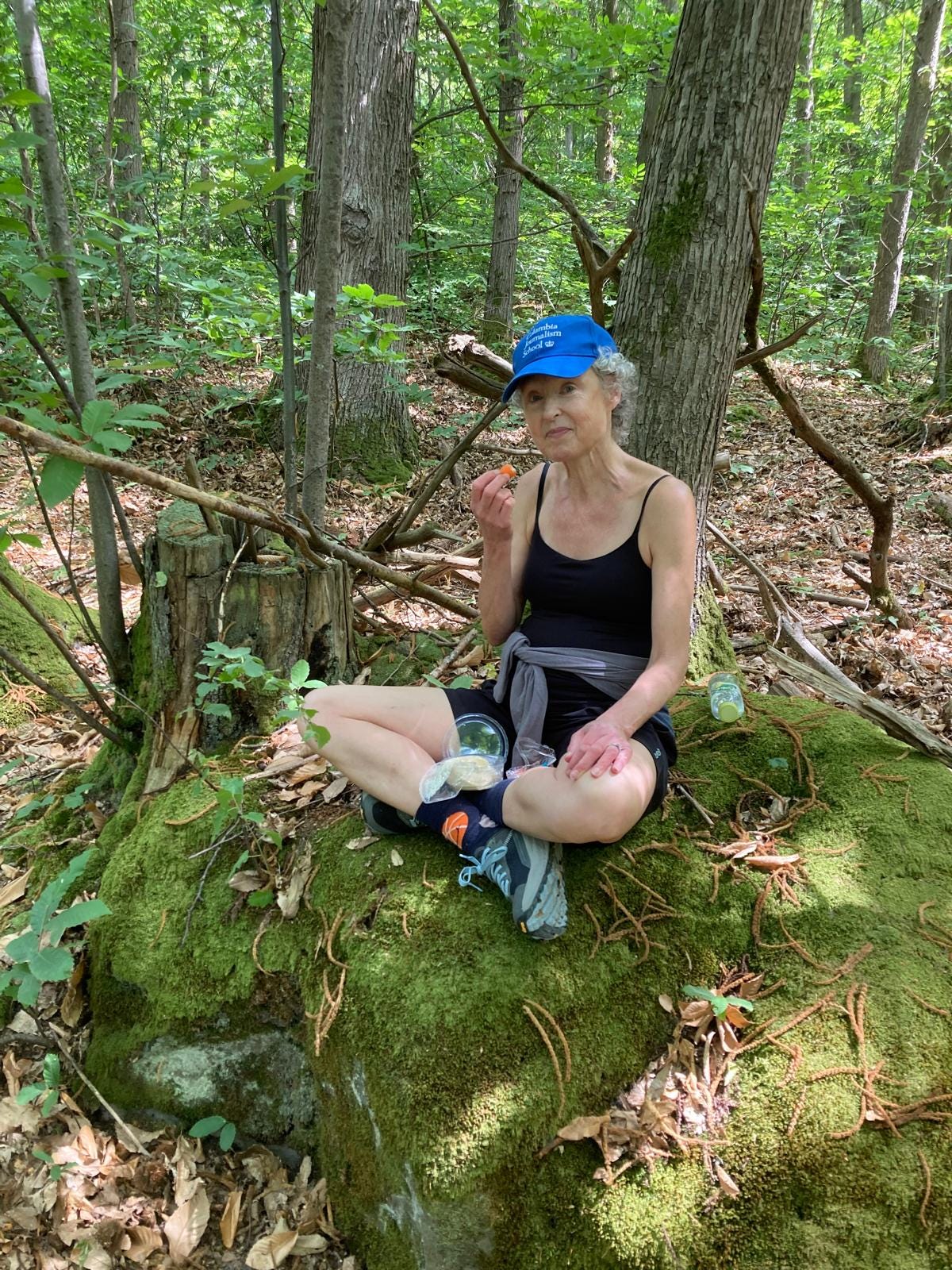
On a day without medical appointments, Tim and I took a 13-kilometer hike. A long trail winds around the periphery of Paris, threading through dense forest and occasionally crossing roads. It was a perfect day, cool and sunny. Most of the trail was in the shade of tall trees and lined with blackberry bushes. Sitting on mossy stones for a picnic lunch, it was hard to believe we were still so close to Paris. At the margins of one village, we stumbled upon a plum tree laden with ripe fruit and stopped to pick them. The tiniest, sweetest little plums. We filled our stomachs and an entire bag.
A new podcast episode
My cousin Zach has an alternate personality, Donnie, who is a wildly popular YouTuber known as The Wonton Don. For many years, he has worked as a foreign news correspondent to Barstool Sports. He also co-hosts a travel podcast called Drop a Pin. Recently, he invited me on the show to talk about our lives abroad. You can listen to our conversation here:
https://www.barstoolsports.com/podcast-episode/e20Cw9bCffyzZDhpnyo15aCX
It was super fun to talk with my cousin. Since we were young, we have rarely lived on the same continent and our conversations have been rare. We touched on a wide range of things, from my anxious adjustment to having a bodyguard in Yemen to my kidnapping and the suicide bomber’s attack on Tim. We also talked about Bolivia and Uzbekistan.
Zach also once stopped a plane passenger from opening an emergency door mid-flight. Here’s how the New York Post reported it:
Book notes
The Things We Never Say
Elizabeth Strout
A beautifully wrought novel about marriage, family, politics, and the things that bind us to this earth and each other, but most of all about our ultimate inability to know each other fully. The protagonist Artie is a schoolteacher, and I found the scenes in his classroom to be among the most moving. He cares deeply about his students and worries for their futures. It is a very contemporary novel, taking place around the time of the last presidential election. Strout thankfully never mentions the president’s name, but makes clear how catastrophic and damaging his regime is at every level, from the classroom to the country. At the same time, Artie wrestles with the discovery of a secret his wife has been keeping from him for decades and its repercussions.
Throughout the book, Artie frets about whether we have free will. In the concluding pages he thinks, “He was on a downward-sloping path, and no matter how hard he would try, he understood that day as he sat in his car that something was going to happen to him and he would not be able to prevent it. Almost, a sense of peace arrived with this. It went through his mind faintly: I will not have the free will to prevent whatever is going to happen to me. And his memory of what seemed to him previously to have been a vigorous wonderment at the concept of free will made him smile just slightly now. He left his car and went inside. Going to his fate, he thought. Just going to my fate, that’s all I can do.”
Clearly this is a sentiment that I relate to. I cannot prevent what is happening to me. I am just going to my fate, that’s all I can do.
No Land to Light On
Yara Zgheib
I wish all Americans would read this book. I was filled with helpless rage—on the behalf of the characters, all too real, and against the current American regime. Also suffused with grief. Sama and Hadi, both Syrian immigrants, meet in the United States. Both are legally there, having endured the exhausting ordeal of finding their way out of a country at war and obtaining visas. But when Hadi goes to the airport to fly home to fetch his parents, he finds himself abruptly deported, despite his legal status. Such things happen in the US with regularity these days. This book makes clear the heartbreak and ruin faced by those who lose everything they have worked for and everything they have built in the US. The deepest pleasure of this book is to be found in the language, lyrical and incisive. Zgheib is an extraordinary writer.
Atmosphere
Taylor Jenkins Reid
This novel brought me so much joy. It’s about astronauts, women, and space, but most of all about love. All kinds of love. Love between friends, between relatives, and romantic love. What a refreshing change it was to read about women astronauts. I could read about women astronauts forever. I could read about women astronauts in love with each other forever. I loved the characters and the particular bonds formed among the astronaut team members. When I finished this book I kept carrying it around because I couldn’t bear that it was over.
God of the Woods
Liz Moore
I listened to the audiobook of this one. I had never heard of the book or its author and have no idea how I came to download it. But if you’re a mystery fan, this is a good one. It also has plenty to say about class, family, summer camps, survival skills, and the power of the woods, in this case the vast and spectacular Adirondacks. Which have personal meaning for me. I adore the Adirondacks and have spent many happy weeks in a writing residency there. Because I cannot physically travel right now, I am grateful I can vicariously get lost in the mountains. In fact, I enjoyed spending time in the Adirondacks so much that when I was finished I searched online for all the novels I could find set in the region.
I have loved following your Substack and journey and followed up on many of your wonderful book recommendations! I lived in Paris eons ago for a few years and still miss it (though glad to be Stateside during these heat waves). There's so much about your writing I have appreciated! But let me simply say I hope you will send that doctor in London the letter he deserves. I am furious on your behalf. I started a letter this summer to a doctor who missed a serious cancer for three years, making its 'cure' impossibly difficult. I understand that anger, and it seems many here do, too. I am determined to let her know how much harm her negligence did. ❤️🩹
After my mother got Stage 3 ovarian cancer with a grapefruit-sized tumor 20 years ago (and she's still alive!), my sisters and I all started getting regular C-125 tests. Then we began getting our ovaries and Fallopian tubes (me and another sister) and just tubes (youngest sister, after having two children) removed for prevention. And I'm adamant about ultrasounds etc... DEMAND YOUR RIGHTS TO HEALTH CARE, ladies!!
The weird thing about having my ovaries out is that now apparently I have no testosterone in my system. Who knew that T was made by ovaries? And we all need testosterone. I can't take estrogen (alas) because of a tiny DCIS breast cancer six years ago (hadn't spread), which means I get to enjoy all the impacts of having no estrogen (fatigue, skin laxity, the rest)... but a specialist hormonal gynecologist in Paris has started me a tiny bit of testosterone, a fraction of what a man would take, to mitigate some of the no-estrogen symptoms, interestingly. Just started so no big results yet.
On a happier note, so glad you read and loved Yara Zgheib's novel NO LIGHT TO LAND ON. I too loved it!!!