

Slipping
A series of medical setbacks; how French teens drink; the value of asking for what you want; and a stunning French performance

I have recently come unmoored, slipped beneath the medical radar. Suddenly no one is overseeing my treatment. No one responds to my persistent emails with urgent questions. In five weeks, no one has offered me a solution for my pain. No one has ever explained this chemo to me. I’ve received two different versions of my schedule and I don’t know which is correct. I no longer see a doctor before each chemo and I don’t know why. There is no one to write me prescriptions or ask me how I am faring on this chemo.
I explained to Fatou, one of my favorite visiting nurses, what has been going on (and not going on) and she said, her large dark eyes understanding, “you feel abandoned.” Fatou is the one who noticed this week that the threads attaching my drain to my body had broken, leaving the drain at great risk of falling out. If this were to happen, I must go immediately to the emergency room, she said. She told me she will try to arrange an urgent appointment for a repair to the drain. This increased my feelings of vulnerability and sent my anxiety level rocketing. “Don’t make any sudden movements,” Fatou said. “You really don’t want this to come out.”
Pain, chemo exhaustion, and fear of losing my drain kept me from walking out of our flat for four days in a row. I curled on the bed, lacking anywhere else to read, feeling unequal to the world. Not recognizing any of the resilience or strength people tell me they see.
Sometimes, when someone calls me resilient, I think: You say resilient like it’s something a person could be made of, something with the quality of rubber, something that allows the bad things to bounce off.
You say resilient like it doesn’t require the impossible: moving through pain, moving into the world, always into it, moving through darkness with your hands held out before you, ready to be stabbed by the unexpected.
You say resilient like I have done my homework correctly.
You say resilient like I have a choice.
I have a choice, okay, I know that.
But just one.
Thankfully, my friend Cat came to see me Saturday. We had tried to think of something to do in central Paris that wouldn’t involve too much walking or sitting, but didn’t come up with much, so Cat just came over for a chat in a local coffeeshop.
One of the good things about Villejuif is that you very rarely hear anyone speaking English. Tourists don’t come here. One of the points of living in France is to continually work to improve my French, so I appreciate this.
In our wandering conversation, we touched on how different the teen drinking culture is here in France, based on what we hear from our teenage daughters. Apparently at parties it is “not cool” to be drunk. Kids will have a drink or two and stop there. We fear our kids will will discover a very different drinking culture when they eventually land in the US, where getting crazy drunk is normalized.
Answers, a new drain, new ways to be drained
After weeks of refusing to answer my emails, Dr. L’s secretary finally gave me an appointment to talk with her. I had a long list of questions. My chemo was canceled this week due to thrombocytopenia, a very low platelet count, as well as anemia. Also, I was right to worry about the two versions of my chemo schedule I had received. Apparently there was new chemo software that the doctors have not gotten to grips with yet, so they have given me the wrong chemo schedule.
Later that day I had surgery to replace my drain. It was painful but endurable. Afterwards, I bled through my bandages due to my low platelet count, but a nurse replaced them and eventually the bleeding stopped.
Because I am willing to explore any offer of help, I’ve seen a homeopath in Spain, who just recommended a molecule he thinks will help me. But it conflicts with caffeine. My heart fell. Dr. J, I said. I don’t drink. I don’t smoke. I don’t take recreational drugs. I don’t eat anything unhealthy. I gave up gluten and dairy and sugar. All that is left to me is caffeine. The promise of coffee and tea is the only thing that allows me to get out of bed in the morning. The ritual, the smell, the first sip. It is embedded in my morning routine. It is what allows me to function and fuels my writing. It gives me the energy to socialize with friends. And now I have to give that up too?
Yes.
I’m trying. I stopped drinking coffee and switched to green tea, a way of tapering. As a result, my quality of life has plummeted. I do not feel equal to the struggle each day requires. I don’t have the energy or focus to write. I cannot stay awake. I spent all afternoon in bed yesterday and then slept twelve hours after dinner. This is not just lack of caffeine, but anemia and crippling depression. The combination of these things mean I cannot imagine getting on the Metro to see friends in Paris. I cannot imagine having the energy for a conversation. I can barely return texts. And I am still drinking green tea! Imagine how I will feel when I stop!
I have spent far too much time feeling sorry for myself this week. I need to find things to do to interrupt the monotony of my day (other than the incessant medical appointment). Breaks from this flat. Breaks from myself. I need to find reasons for short trips to Paris on days I can manage it. Today, I could do nothing but pace the apartment crying and panicking. So Tim took me to see the new film The History of Sound. It was beautiful and haunting. And strangely made me homesick. It helped to focus my mind outside of myself. I frankly don’t feel like thinking about myself or my life ever again.
A happier story from my earlier life: Sometimes all you need to do is ask
Like so many women, I have never asked for enough money for my work. I never asked for a raise at any job. I accepted the tiny, incremental pennies they offered for each additional year. I accepted every condition.
In 2000, before NYC life altered forever, I was working away in my cubicle at Folio: magazine when my phone rang. It was Gary Izzo, director of the Sterling Renaissance Faire in Oswego, NY. I had performed with his company of actors before, in 1995. We stayed in touch. I’ve just lost a washer wench, he said. Is there any chance you could step in this summer?
When I worked as an actor, I was constantly underemployed. The problem with being an actor is you spend so much time waiting around for someone to let you do your work. Unless you’re working on a one-woman show, you can’t just be an actor without permission from a casting agent, director, or producer. This was one of the things I found the most frustrating, the needing other people to give me permission to work. I wanted to work all the time.
(This is one of the many pleasures of writing; I don’t need to wait around for anyone to say, “Okay, you can work now.” I can work all hours of the day or night if I need to. Still, I miss the theater, particularly because of its communal nature. I miss the rehearsal process, the discoveries made with other people).
Gary’s offer was dazzling. The two washer wenches got to write their own comedic shows and perform them several times a day at the festival. Some of the best and funniest actors I have known have been washer wenches. Washer wenches were part of a broader company of actors, most of whom were professional actors taking a break from NYC or elsewhere. I knew from experience the actors in Gary’s company were quality. I knew from experience that Gary himself was quality. The overall experience of being a part of that festival was magic. I would live in the woods on the site of the faire, a cluster of faux Elizabethan pubs and ateliers. I would walk on the damp grass in my bare feet from my loft to the communal bathrooms, lie on my back in the parking lot to look at the thick clouds of stars, play zombie late at night in the maze. Make friends for life.
But I had no savings, and while the Faire paid its actors, it wasn’t enough that I could afford to quit my job for good. My desperation to spend my summer performing won out over my cowardice, and I knocked on the door of my boss, Tony. What do you need? he asked.
I took a breath. “I would like to take a summer job performing with a theatre company upstate. I could do some freelance work for you while up there. And I would like my job back at the end of the summer.”
Startled, Tony sat down to think about this. He asked me a series of questions, before saying, “All right, that sounds fine.”
I was stunned. Apparently sometimes all you had to do to get what you want was to ask for it. I had never asked anything of my bosses, never wanted to be seen as overvaluing myself. I believed the price tag they put on me. It has taken most of my life for me to figure out what my work is worth.
My brightest spot this week:
Amadeus
Peter Shaffer
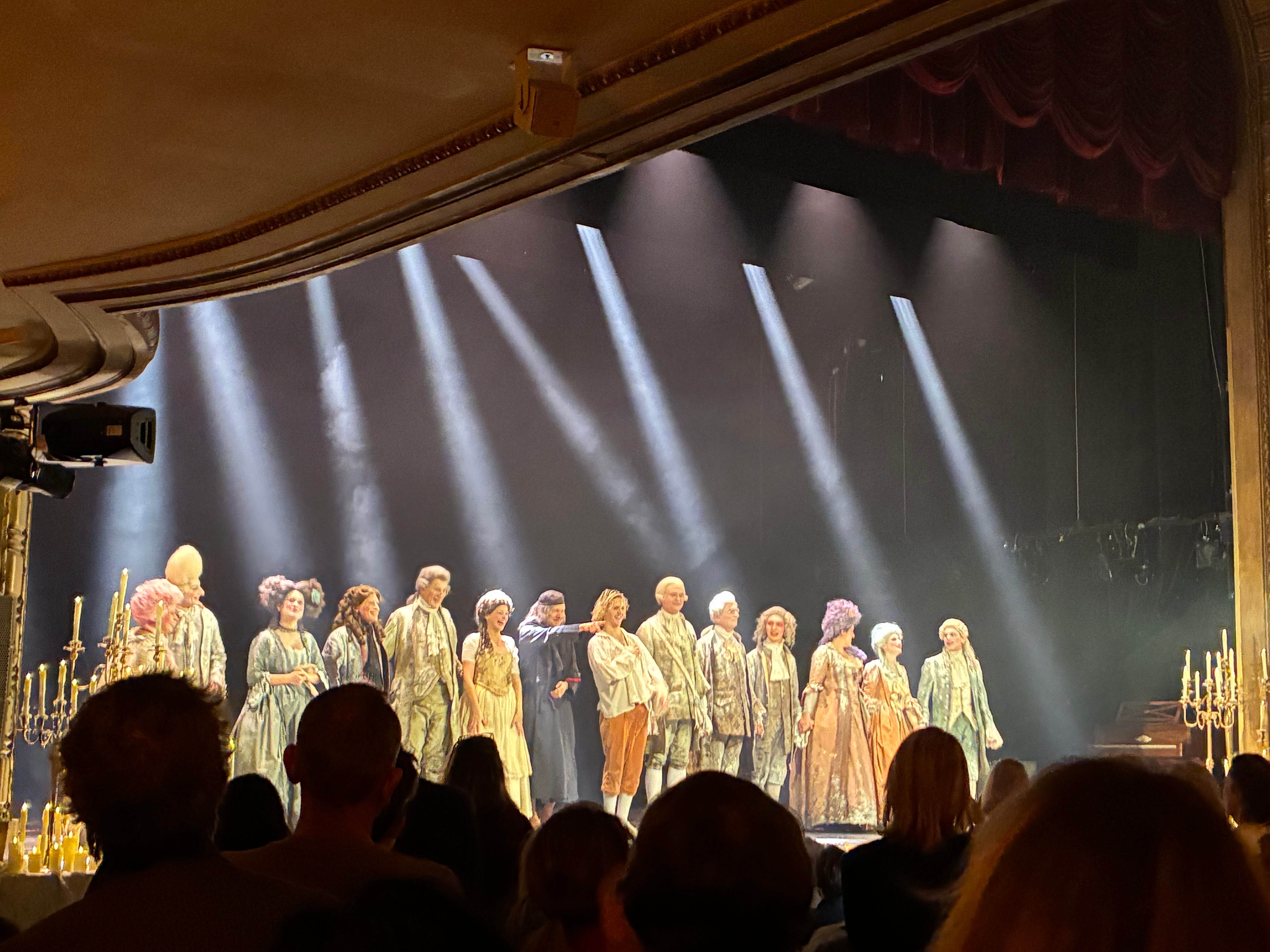
A generous friend took me and Theo to see a performance of Peter Shaffer’s Amadeus at the Théâtre Marigny this week.
While I have seen Amadeus before—it was the first Broadway show I ever saw, when I was around twelve years old—this performance caused me such acute heartbreak I don’t think I could bear to see it again, could bear to see Mozart extinguished again. It made me almost physically ill. This speaks to the power of the performance.
I noticed more acutely than ever before how much time we are forced to spend with Salieri, how little time we get with the far more engaging and authentic spark of Mozart. I viscerally felt myself deprived of Mozart, deadened by Salieri’s mediocrity cruelty. Tim referred to Mozart as an appalling man. But he came across as the only authentic person in his world. Neither Theo nor I find fart jokes entertaining; Mozart’s sense of humor in the play is not ours. But we appreciated how he and Constanze, at least in this performance, shared a lewd sensibility that ultimately came over as playful and affectionate. They used crude humor like a shared language.
The music, of course, was a highlight, the way it bloomed from the play like a Dinnerplate Dahlia in a vacant lot of weeds, shone like sunlight over a grim world. It made me hunger for more, more years of Mozart’s life, more music, much more music. Think of how much more he could have created. Imagine him in his fifties! What would he be composing then? Whatever it would have been, we are impoverished by its loss.
A strange quirk of French theatre performances is that they very rarely include intermissions. Theo, who goes to the theatre regularly as part of her schoolwork, says she has never been to a play that had an intermission, no matter how long it was. Amadeus was two and a half hours long with no intermission, a challenge for small bladders or the disabled who cannot sit without moving for so long. Matthew Bourne’s Swan Lake was also performed without an intermission. I understand the desire to keep the audience immersed in the story, but there is a point at which personal discomfort begins to distract from the show. I think anything lasting more than 90 minutes ought to offer at least a brief stretching interval.
I’ve also yet to see a French theatre that offers coffee or any other drink or any food. While I often wish for a stimulating beverage before a show, I do not miss the presence of snacks. British theatregoers insist on drinking gin and tonics and eating through bags of snacks throughout every performance, which I find monumentally distracting. The constant click of the ice cubes, the slurping, the rattling of crisp packets, the mastication. It all enrages and disgusts me. I feel like people can stop eating for an hour or two in order to allow their seatmates to focus on the performance. During Amadeus yesterday, no one drank anything. No one ate anything. No one’s cell phone rang. It was blissful. I could just dissolve into the experience of the play.
Film/Play recommendation: Marcel Pagnol’s Marseille Trilogy from the 1930s, Marius, Fanny, and César.
Each of these tragicomic plays/films focuses on a different character living within a close community by the docks of Marseille. The first focuses on Marius, a young barman in love with the sea, who dreams of running off to see the world. He also is in love with his childhood friend Fanny, and the tension between those two loves—three, actually, as he deeply loves his father—drives the plot. The characters are funny and flawed and wise. They cheat at cards, they sneak around, they yell at each other, yet they remain close-knit, forgiving. The second film focuses on Fanny and the decisions she is forced to make after Marius abandons her. I have not yet seen the third, which focuses on Marius’s father. There is a gentleness in these characters, despite their frequent impassioned arguments. I am fond of them, and love this glimpse of life in Marseille in the 1930s. Tim found a restoration of the original films at our local library. They were among the first films with sound, and some of the acting styles are reminiscent of those of melodramatic silent films. Yet they are fully realized people, whose comic bluster gives way to moments of honest emotion and thoughtfulness.
Jennifer, it has been many moons since I saw you last, in London for our reading at Book and Kitchen in Notting Hill and then in Chelsea for coffee (if I remember well!). Suffice to say 'lots has happened since.' For now, I just want to say that your personal story – interwoven with everything from news and stories about other countries, to stories about Paris (and Paris hospitals, hotels, museums, and bookstores!), to your reflections about books, politics, friends, and more – makes every posti so unique and interesting to read. There is so much substance and meaning here. And it's just so rare to see this kind of weaving of the personal and worldly!
Glad you finally were able to see the doctor. Being at the mercy of stupid software sounds maddening. If you're looking for some in-home entertainment, you might consider the old BBC version of "I, Claudius". All the episodes are available free on YouTube. The 1970s production values are a bit of a chuckle but much of the acting is quite good. We found it a pleasant rabbit hole to go down, and ended up watching the whole thing.