

Why I overshare
and why you might consider it. Plus, the best bookseller in Paris, revivifying outings, and a medical update.

A hot, sleepy week. On Monday I had just arrived at a birthday picnic for my friend Cat when the lab called to tell me my haemoglobin was 7.7, below the transfusion threshold. I asked if I should head to the hospital, but the doctor told me I could wait a couple of days. Monday was a holiday after all. “Just call back if you have pain in your heart,” he said.
When I headed to the hospital two days later the doctors were unsmiling. My tumor markers are rising, I have gained four kilograms of ascites, so the cancer is progressing. Yet my bloods were too devastated for chemo. They were even lower than they were on Monday. Thus the only thing they could do was order the blood transfusion, a puncture for the ascites, and a scan.
I begged Dr. O to find my a study and she said she was always looking. The problem is that I am on my fifth line of chemo and the more lines of chemo I have, the less likely I am to be admitted to a study. I feel trapped.
I then scuttled upstairs to a social services appointment and to therapy. My therapist was late and we just had fifteen minutes. I told her my situation and that I was feeling depressed. She never has anything to say. She asks me the occasional question, but has no suggestions of coping mechanisms and doesn’t offer new perspectives. I don’t know why I keep seeing her. Troy is so much better, but I don’t get to see him very often. “I get the feeling you are detached,” she told me. I don’t know about that. Hadn’t I just told her I was depressed and defeated?
The hospital gave me a free lunch, which it always does when you have to spend an entire day there. So this is very nice. They give you a salad or sandwich, plus a compote or yoghurt, bread, and a drink. It’s very generous.
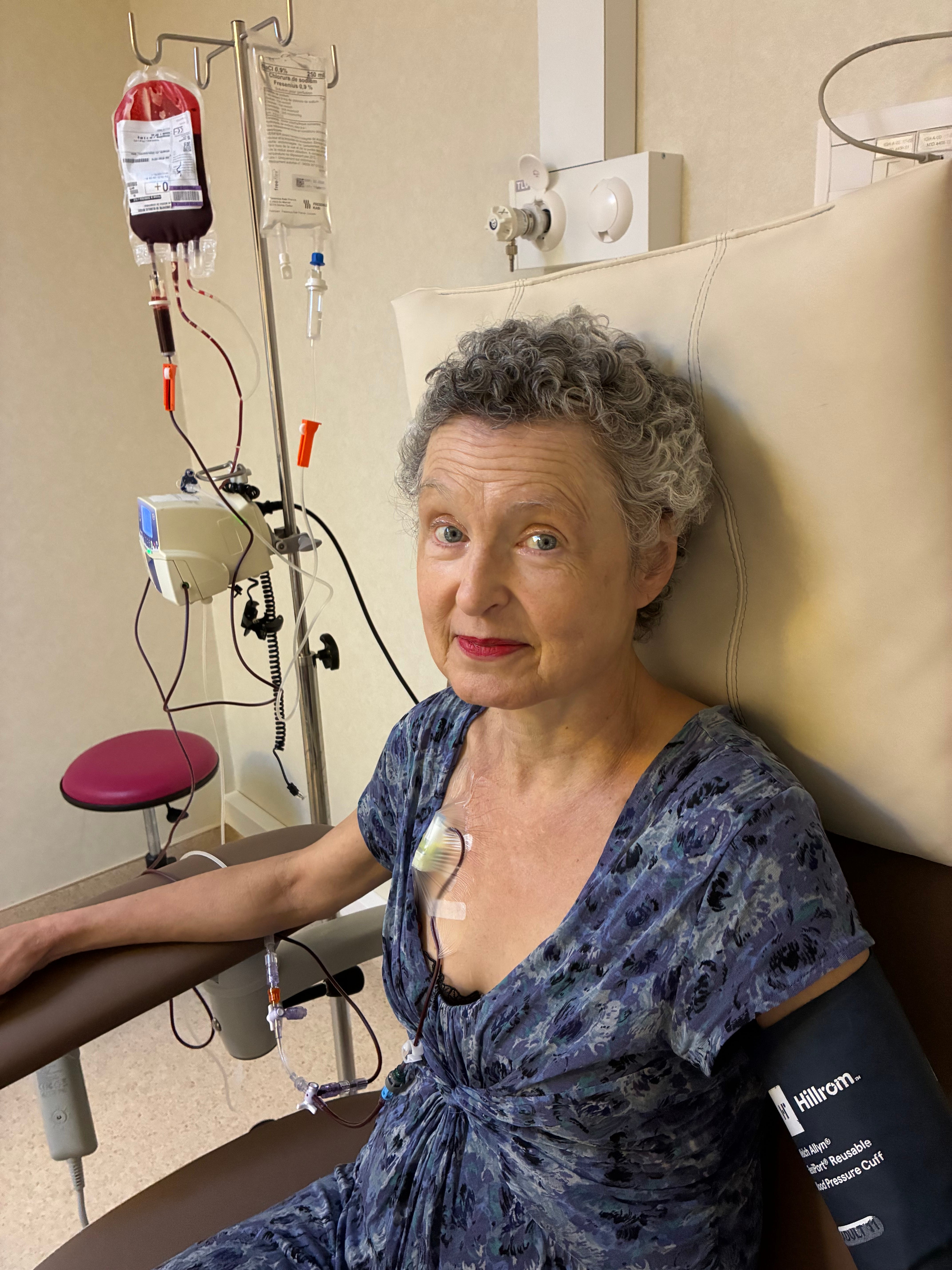
I had the blood transfusion in the afternoon. Two bags of blood. It was supposed to take just an hour per bag of blood, but the nurse forgot to launch the second bag until it started beeping, so we ran late. Then my blood pressure was too high for them to let me go. Lots of new blood in the veins/arteries increases blood pressure dramatically, but usually briefly. My blood pressure remained high for longer than normal, so a doctor came to see me and they gave me Lasix to make me pee out extra fluid. “Does your head hurt? Are you dizzy?” they kept asking me. But no. The Lasix apparently helped. My blood pressure started to decline and they let us go.
Receiving blood is always an emotional experience. I’m tearful with gratitude for the blood, and worried I am using up too much of it. What if there is a car accident and a victim urgently needs this blood? Many of you have written to say you are donating blood, which makes me happy. If I am inspiring more people to give blood then perhaps I can stop feeling so guilty for using it.
Despite the blood, I’m still unable to stop sleeping. Here’s the problem. In the UK, the threshold for a transfusion is higher, so you get blood before you’re in crisis and you feel better immediately because the transfusion takes your haemoglobin up to normal. But here, the transfusion threshold is so low that even after a transfusion your haemoglobin remains well below normal. So you never feel better. I cannot remember what it feels like to have energy.
Despite this, I did manage to meet a friend from London for lunch. When I do something this ordinary, I shift from the despair of my hospital days into the brain of a functional human. I listen, I tell stories, I don’t think about cancer.
During our wandering conversation, we landed inevitably on AI. She has been teaching and talked about usual appalling level of grammar and punctuation in UK university students, and how suddenly this year, everyone’s papers are perfect. AI, of course. Why do people even go to university if they don’t want to learn? They’d be better off saving the money and time, if they are unwilling to work for their education. So many wasted years!
So much has changed since I was teaching at Bournemouth University, when students still turned in papers riddled with grammatical and punctuation errors. This was a serious problem. I’ve written long letters to students on why grammar and punctuation matter. How they allow us to communicate with each other, how they change the meaning of sentences. I’ve explained that learning how to communicate in writing is not useful only for people planning to be writers, it is useful for anyone planning to write an email to a boss or a coworker and not sound like an inarticulate child.
Now people will argue that everyone will use AI to write their emails. But why do people not want to express their own thoughts? I don’t understand the impulse to hand over work to a machine. It’s just so lazy. Studies have already shown that our cognitive abilities diminish when we hand over our thinking to something else. Our brains die if they are not used. I thus refuse to hand over even the most mundane of my tasks to AI.
Here’s something else I don’t understand. Why do so many people believe they have “romantic” or “friendly” relationships with AI? Do so many people just not understand they are interacting with a machine? I’m shocked by how many people are deluded into thinking there is something real about their relationships with AI. I don’t understand why it is comforting to receive positive feedback or words of consolation from a soulless machine. I can’t imagine feeling connection to anything nonhuman or nonanimal. Yet so, so many people feel otherwise. We seem to be living in a time of grand delusion, when no one can stand to reach out to real humans or have real human relationships. It makes me so infinitely sad. This loss. I hate the world I am leaving for my daughter.
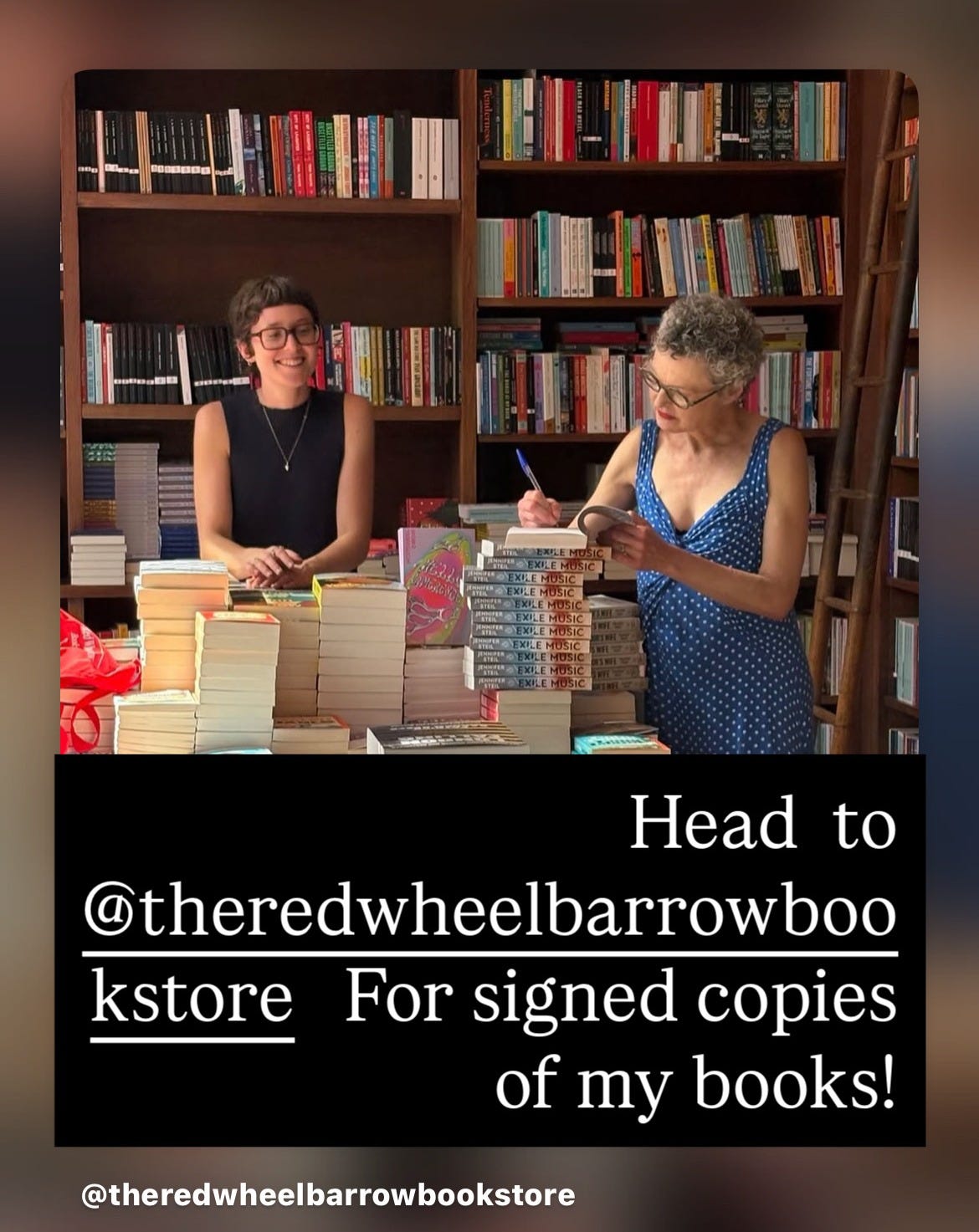
On my way home I headed to the Red Wheelbarrow Bookstore, where I ended up spending the rest of my afternoon (standing in front of the fan). It’s so much fun to talk with readers and of course with Penelope and her staff. Even after the bookstore was officially closed, people wandered in. “Are you open?” one latecomer asked. “Technically we’re open,” Penelope said, “but emotionally we are closed.” Which did not deter him from coming in, nor did it deter Penelope from welcoming him.
Penelope impulsively invited me to accompany her to a literary soirée nearby, and while I was worried about my energy and the heat, I didn’t want to miss the opportunity to spend more time with her. It was an entertaining outing. I met all kinds of writers and artists, drank all the kombucha at the open bar, and ate most of the Marcona almonds. A few people shared some deeply personal stories with me, after I confessed to being in cancer treatment.
I’ve always been an oversharer. If there is any detail about my life that interests a listener, I am happy to share it. I am aware that there are times this habit of mine can make a listener uncomfortable, with its assumed intimacy. Yet I continue, because I feel like if I am going to have a relationship of any kind with someone, they ought to know me as I really am. I don’t want them to learn to love some surface version of me. I don’t want to perform a polite, discreet version that doesn’t represent the bloody mess of my insides. I don’t want relationships based on a society’s conception of what are suitable conversation topics.
Right now, it is particularly hard for me to keep anything to myself. The moment I go to any event, any gathering, someone asks me why I moved to Paris. So my answer to that very first, polite question is that I am trying to save my life, or at least prolong it. It would never occur to me to lie. If people aren’t comfortable with my cancer or my thoughts on mortality, they are free to step back, to step away. But my cancer and my treatment is not something I have the strength to hide even should I want to. It consumes my days, my thoughts, drains my emotions.
I don’t want people to think of me purely in these terms, of course. Once I have answered that first polite question I am happy to turn the conversation toward literature, writing, art. I don’t have any desire to wallow.
I imagine myself like a dog or cat rolled over on my back, exposing my vulnerable tummy for affection. If I willingly expose my vulnerabilities, perhaps people will answer me by exposing their own. This, it is my hope, allows us to meet in a more genuine place. A place where we stop presenting a version of ourselves and just show each other our soft bellies.
This is not to say that I have no secrets. There are a few I will take to my grave because they could hurt living people. They don’t reveal anything useful about who I am now. Perhaps they reveal an aspect of who I was in my twenties or thirties, but not now. No one need dredge up every detail of her past.
But back to the soirée. Perhaps the best part of the evening was that Penelope accompanied me all the way home, to see that I made it safely. She not only rode the Metro all the way to Villejuif, but walked me to my apartment door. She lives at the opposite end of Paris and had a long commute home. I was deeply touched. How many booksellers would do such a thing for an author?
Speaking of which, signed copies of my books are available at the Red Wheelbarrow! And if you let me know you are going, I will attempt to meet you there to personalize the signature.
Despite the continued heat wave, I needed to leave the flat once a day to feel I was alive. So I was fortunate that I also had a visit from an American author from Eugene, Oregon. Both of our forthcoming novels will be published by Regal House, so we thought it would be fun to meet up. Which it was. We met for coffee and didn’t stop talking until she looked at her watch and we realized three hours had passed. Look for Amalia Gladhart’s novel Edge Pieces in 2028!
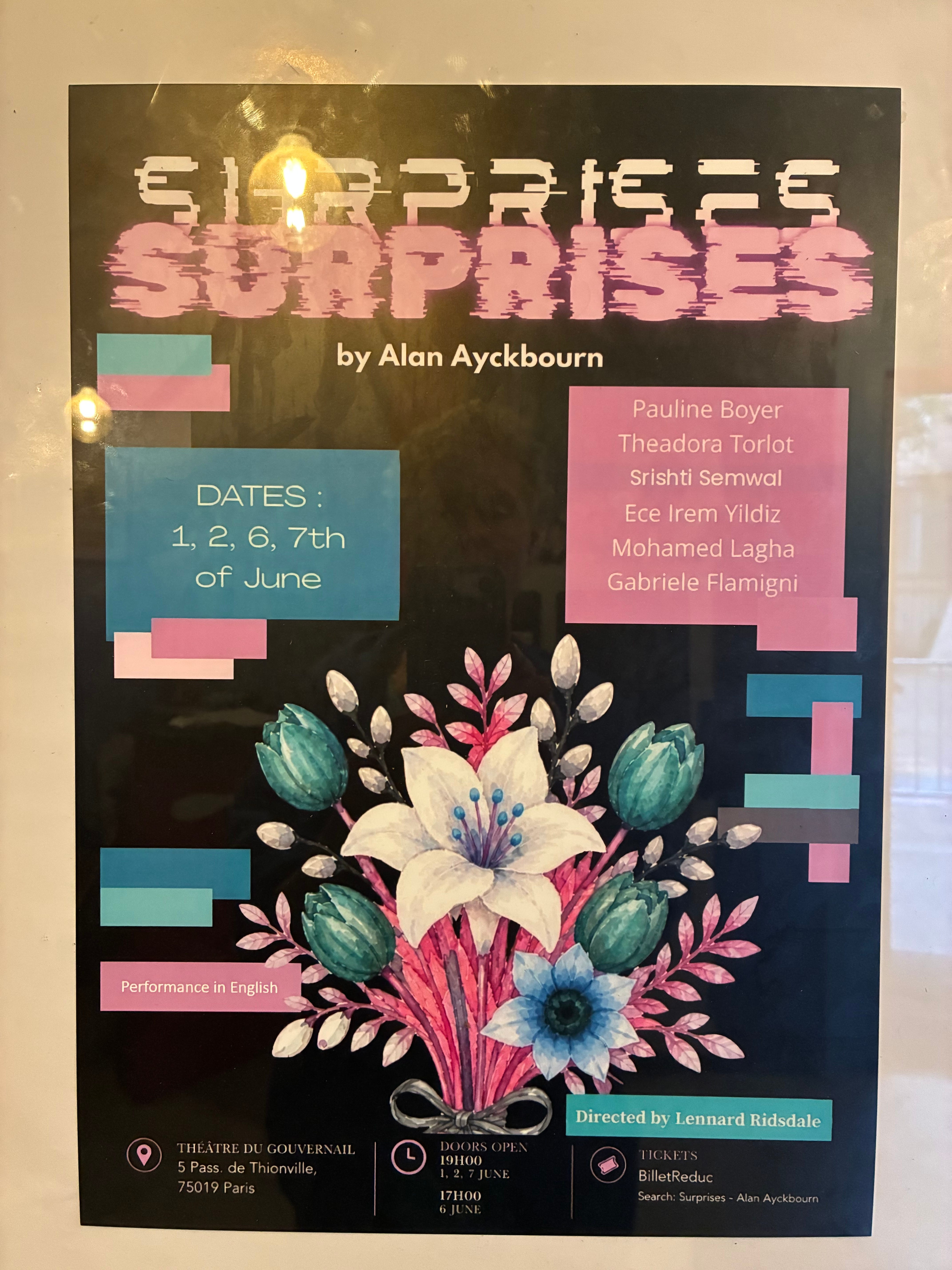
This week also brought two theater outings to see our daughter perform. On Sunday she played Menelaus in the first act of Jean-François Sivadier’s Portrait de Famille. The following evening was the opening night of Alan Ayckbourn’s play Surprises, in which Theo played Grace. It was the perfect role for her. If you are in Paris, do go see the play, which is in English! While my opinion is completely biased, I did really enjoy the production (and my daughter’s stunning performance—sorry, couldn’t help adding that!). Theo has had so much schoolwork preparing for her French and Math baccalaureate exams that she hasn’t been sleeping, so I don’t know how she manages these performances on top of everything.
Today I found out that, despite my continuing inability to stay out of bed for too many hours at a time, I will probably have chemo tomorrow. I don’t know what kind, since the kind I’ve been receiving has stopped working. I fear this will end up meaning another low spell and another transfusion, but I’m not making the decisions here.
As a postscript, I want to reiterate how much it means to me to have you here, reading my words, liking my posts, and sending me messages. This is one of my sole sources of income, and we continue to live on the edge financially, so I am especially grateful to those of you who are paying subscribers. You make everything possible for us! Have a cool and peaceful week.
Dear Jennifer: I appreciate your over sharing and your essential decision to keep loving the time you have on this planet . An inspiration to me. I would like to send you a book about “seeing into the life of things “ if you give me your address I will. Best and love , Moira PS planning to be in Paris late September and hope to see you there.
Jennifer, thank you, as always, for sharing how you encounter and process our shared world. This part particularly hit on a place where I've been in my mind lately: "I don’t want to perform a polite, discreet version that doesn’t represent the bloody mess of my insides. I don’t want relationships based on a society’s conception of what are suitable conversation topics." As you know, I am still swimming in, and marveling at, and frustrated by the slowness of, my ongoing recovery from last year's bike wrecks, and part of that is a level of gratitude for anyone in my life, even if their impact on shaping me has been the most peripheral of butterfly-wing flutters. And as part of that, I am resolved to share what's in me with all. The "before" version of me was almost painfully quiet and reserved, with most of my thoughts running through multiple filters of not-wanting-to-trouble-others with whatever it was I was thinking. Now I almost crave the humanity of interaction, even (and maybe especially) if it involves an expression that may be deemed unfit for the conversational strictures of polite or professional company. I don't care as much about who may read a post, or about what the professionally appropriate limits are on sentences I utter over a phone or type into an email to other attorneys, or about whether I am cool or accomplished enough in art in my conversations with brother and sister artists and writers. I have long longed to not be defined by my profession or by social structures, but I have lived often and expressed myself often within those defined boundaries. No more. We are all of us humans, carrying the potential of and deserving of the grace of our humanity. Why should we not express to each other the fullness of the human thoughts and vulnerabilities we contain? If we all just let go of the constructions imposed by "polite society," if we all "overshared," if the world were full of you and full of me and full of Tim and Theo and full of Nicole and Lucie and Eli and Max. If we were all willing to be vulnerable, then those united and amassed vulnerabilities would become our strength.
Sorry. You just hit a place where I've been thinking a lot lately. I appreciate you.
On the AI of it all, I've found for the first time in my almost ten years of teaching a law school course where the final grade is based on a large research and policy paper that I appreciate the poor grammar and misspellings that slip into the papers, feeling that this mean that at least the student was attempting this and not just shifting it over to an AI bot (though I also wonder if the AI is not just throwing in grammatical errors to make me think it's human). I sigh, largely.